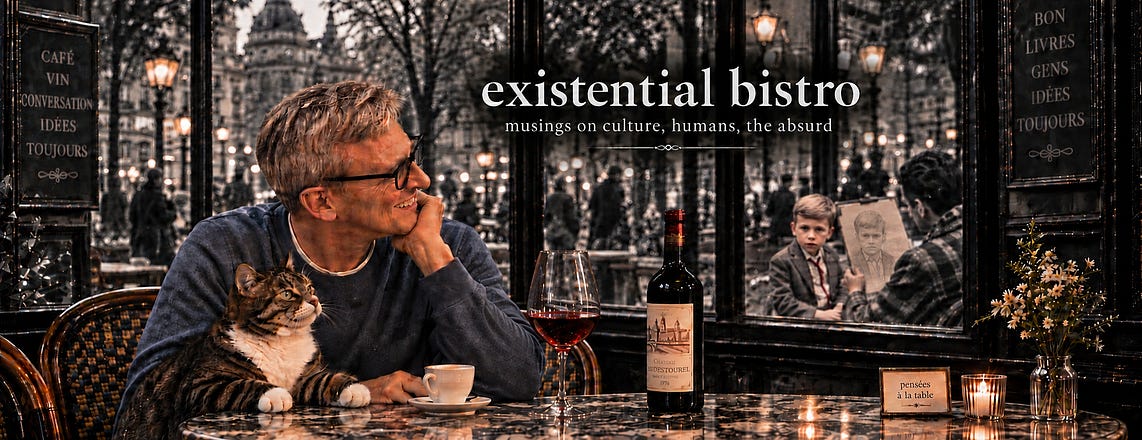
I’ve dreamed of thinking and writing…and writing and thinking…for as long as I can remember. I’ve been blessed to flirt around the edges of my indulgence for much of my academic, personal, and professional lives, building up a robust portfolio of my own experiences full of traumas and triumphs and reflections on both the everyday and the extraordinary…bolstered by immersion in an incredibly rich, diverse range of humanity.
As a high school junior I won a very local award for a short story I wrote about our cat. As an immature sophomore at my a-little-too-good-for-me small liberal arts college in North Carolina — admission likely relaxed as a recruited tennis player — I encountered Existentialism…and Nietzsche. A middling philosophy major I would become, holding on tight to my draw to existentialism as a lighthouse that has flickered through the years to now. As the days to college graduation quickened with absolutely no idea what I was going to do, a senior thesis on Nietzsche and Christianity led to hurried thoughts about divinity school or graduate study in philosophy.
I chose philosophy at Boston College, made more attractive by an invitation to live with a close friend and fellow philosophy major who would be a first year at Harvard Law. My year in Boston was pivotal. I was challenged to grow beyond some traditional boundaries. I also lucked into a couple of courses with an esteemed Jesuit philosophy professor who was an internationally recognized expert on Heidegger, as well as a Paris-trained Lacanian psychoanalyst. I actually read Being and Time from cover to cover over a two semester course! With that professor’s help I found my way to a PhD program in clinical psychology with an existential-phenomenological orientation in Pittsburgh.
My Steel City years were sometimes dark and difficult. I had some medical issues in my mid-20s that compromised my sense of physical integrity. As an enthusiastic, budding existentialist I already had pondered death, temporality, and random fate more than I should. Being diagnosed with a rare cardiac condition associated with sudden death in the setting of having my facial structure surgically corrected only magnified my vulnerability to dysphoria and dysmorphia. Brighter notes included living with a gifted, kindred-soul friend who speaks on schizophrenia and recovery all over the world.
I also thrived at my first real job earning $11,500 a year as a therapist at a long term residential treatment program for heroin addicts, several of whom would hang out with me in the staff office until 3:00 am debating God, exploring racism, and in general educating me about Vietnam trauma and things I was still too young and sheltered to truly understand. For my dissertation I harkened back to my old friend Nietzsche and his concept of ressentiment, yielding a phenomenological study titled The Persistent Character of Resentment.
I found my groove at St Elizabeths Hospital in Washington, DC, one of the most famed “insane asylums” in the country. When interviewing for a spot in the clinical psychology training program I fell in love and knew I had to be there. On the first go round, acceptance looked promising until I got the dreaded call of being the “first person on the waiting list” to not get in. Devastated, but still determined, I applied for and was accepted for a psychodrama residency year at St. E’s. Despite really sucking at psychodrama my desperation to get my foot in the door paid off as I was accepted into the psychology program for the following year. Three years later, I was the chief resident, married, and with a child soon to be on the way.
Another dear, brilliant friend from my St. E’s internship year helped recruit me to Bridgewater State Hospital in Massachusetts, a maximum security forensic psychiatric hospital still overcoming the lingering effects of Titicut Follies, a shocking 1967 documentary by Frederick Wiseman exposing inhumane conditions. I worked my way into senior roles, followed by a handful of years at another secure facility directly adjacent to Bridgewater as director of the treatment program for men adjudicated as sexually dangerous persons. I had stints providing clinical supervision and oversight for mental health services at a women’s prison in New Mexico, a sex offender program in Wyoming, and the Suffolk County jail in Boston. I served as chief forensic examiner for New Hampshire.
I’ve more recently worked as a senior forensic psychologist in court clinics, conducting evaluations regarding competency to stand trial, insanity, and psychiatric and substance abuse commitments, and in consultative roles. Today, mostly retired with space to reflect on my journey, I can more fully appreciate my encounters with thousands of human beings across the diagnostic spectrum and spanning an array of demographic backgrounds, as well as my relationships with a heterogeneous panoply of inspiring mentors, peers, and supervisees.
I’m becoming acutely aware that my time left may be measured in a decade or two, or less. It’s hard not to wonder if I will see my young grandchildren through high school or beyond college. The clock of course was always ticking, but with the specter of the end more unavoidable, the ticking has become unmuted and a little louder. I am more alive with an urgency to finally do exactly what I want as a full-time gig — think and write — even if ultimately its only for my own self-edification and a wild swing at chasing hints of immortality. The greatest gift of death is enabling and giving definition, contours and meaning to life.
The idea of Existential Bistro evokes the kind of place I most want to live — engaging authentically with empathy but without fear, and free from exploitation, while drawing on the mural of still accumulating life experiences in my mind as the raw material for painting words on a page. You will encounter the Philosopher Cat, and the idea of the elephant…forgetting nothing, speaking the unspoken.
Subscribe to get full access to the newsletter and publication archives.
